Jade CommunicationsJust a few days into 2026, Nairobi was shaken by two separate building collapses in South C and Karen. Beyond the tragic loss of life and injuries, the incidents exposed persistent weaknesses not only in construction oversight and emergency response but also in how institutions communicate during crises.These events highlighted a crucial fact: while technical failures may trigger crises, communication failures often shape how the public perceives accountability and trustworthiness.Crises unfold amid uncertainty, fear, and scrutiny. In such moments, institutions are judged not only by what they do, but by what they say, how quickly they say it, and how consistently they communicate.Crisis communicationCrisis communication refers to the structured and coordinated dissemination of information before, during, and after events that threaten lives, public safety, operations, or institutional credibility. It is designed to guide public behaviour, reduce misinformation, and maintain trust in an institution. Unlike routine communication, crisis communication operates under severe time constraints and incomplete information, requiring clear and transparent messages.Failing to communicate promptly leaves information gaps, quickly filled by rumours. Conversely, timely and honest messages stabilise public sentiment, reassure affected communities, and signal accountability.Case study 1: South C building collapseOn January 2, 2026, a multi-storey building under construction collapsed in South C, triggering an emergency response involving county authorities, national agencies, and humanitarian actors. While rescue efforts were visible and immediate, public communication lagged behind events on the ground. There was no clearly identifiable spokesperson providing authoritative updates or context in the critical early stages.Initial messages focused mainly on rescue operations, with limited information on casualties, regulatory approvals, or possible causes of the collapse. As a result, key public concerns were left unanswered, feeding their anxiety. Information reached the public primarily through live media reporting and social media posts by journalists and eyewitnesses, rather than through official channels.This communication gap created a fertile ground for speculation. Online narratives around corruption, regulatory failure, and negligence gained traction, amplified by public frustration and political commentary. Public sentiment shifted rapidly from shock to suspicion and anger. From a crisis communication perspective, the response was fragmented and reactive, failing to project leadership or narrative control.A more effective approach would have involved the early designation of a spokesperson to acknowledge the tragedy, express empathy to those affected, outline what was known, and commit to regular updates. Even limited, consistent information could have reduced misinformation and stabilised public confidence.Case study 2: Karen building collapseBarely a week later, another building under construction collapsed in Karen, resulting in fatalities and injuries. This time, communication from authorities was noticeably faster and more assertive. Statements from the National Construction Authority and the Nairobi County Government clarified that the building was unregistered and that preliminary findings indicated structural failures during construction. The suspension of the site pending investigations was announced publicly.This response demonstrated a clearer application of crisis communication principles. Messaging extended beyond rescue efforts to address accountability and enforcement, and information was disseminated through media briefings and official statements that were quickly amplified by mainstream and digital media.Public sentiment, while still marked by concern and grief, was comparatively more measured. The communication reassured the public that action was being taken. However, some challenges remained, particularly brief confusion caused by statements from different agencies being released at different times. Greater coordination through joint briefings could have further strengthened message consistency.What these cases teach us about crisis communicationThe contrast between the South C and Karen incidents highlights that crises are shaped not only by the events themselves but by how authorities communicate in real time. Where communication is delayed or inconsistent, public anxiety and speculation grow; where it is timely and clear, confidence and trust can be maintained even amid tragedy.Taken together, these cases demonstrate that crisis communication effectiveness depends largely on preparedness. Institutions that lack clear structures and protocols struggle to communicate effectively under pressure, while those that apply lessons and frameworks can improve. They also show that the public evaluates institutions as much on communication behaviour as on operational response.How organisations can build an effective crisis communication policyWhen it comes to crisis, it is usually not a matter of if, but when. This means that every organisation, ought to plan for that time. As the year begins, it is critical to either develop or review an existing crisis communication policy. An effective crisis communication policy begins with clarity. Organisations must define what constitutes a crisis and establish clear triggers for activating crisis communication procedures. This ensures a timely response and avoids delays caused by internal uncertainty.Central to any policy is the designation of a crisis communication team with clearly defined roles. This includes a communication lead responsible for coordination, authorised spokespersons, and technical experts who provide verified information. Restricting public communication to designated spokespersons ensures that the message remains credible.Preparation is critical. Organisations should invest in pre-crisis planning, including media training, scenario simulations, updated contact lists, and pre-approved holding statements for foreseeable risks. This preparation enables institutions to respond quickly and confidently without sacrificing accuracy.Transparency and timeliness are essential principles. Institutions should communicate what is known, acknowledge what remains under investigation, and commit to providing updates. Silence or “no comment” responses undermine trust and allow misinformation to flourish.Internal communication is equally important. Staff must be informed early and clearly to prevent confusion, anxiety, and unauthorised disclosures. Internally aligned institutions communicate more consistently and credibly externally.Finally, crisis communication must be linked to visible action. Announcements of investigations, suspensions, or policy reviews reinforce accountability. Post-crisis communication, including lessons learned and reforms, is essential for restoring trust.       Prioritising crisis communicationThe building collapses in South C, and Karen were tragic reminder of the human cost of regulatory and technical failures. They also tested how institutions communicate during crises. As these events demonstrate, poor communication can fuel mistrust, whereas clear, transparent, and timely messages can help maintain public confidence even in the midst of tragedy. Organisations that prioritise clear policies, designated leadership, preparedness, and accountability are better positioned to manage crises and to preserve credibility in their aftermath.
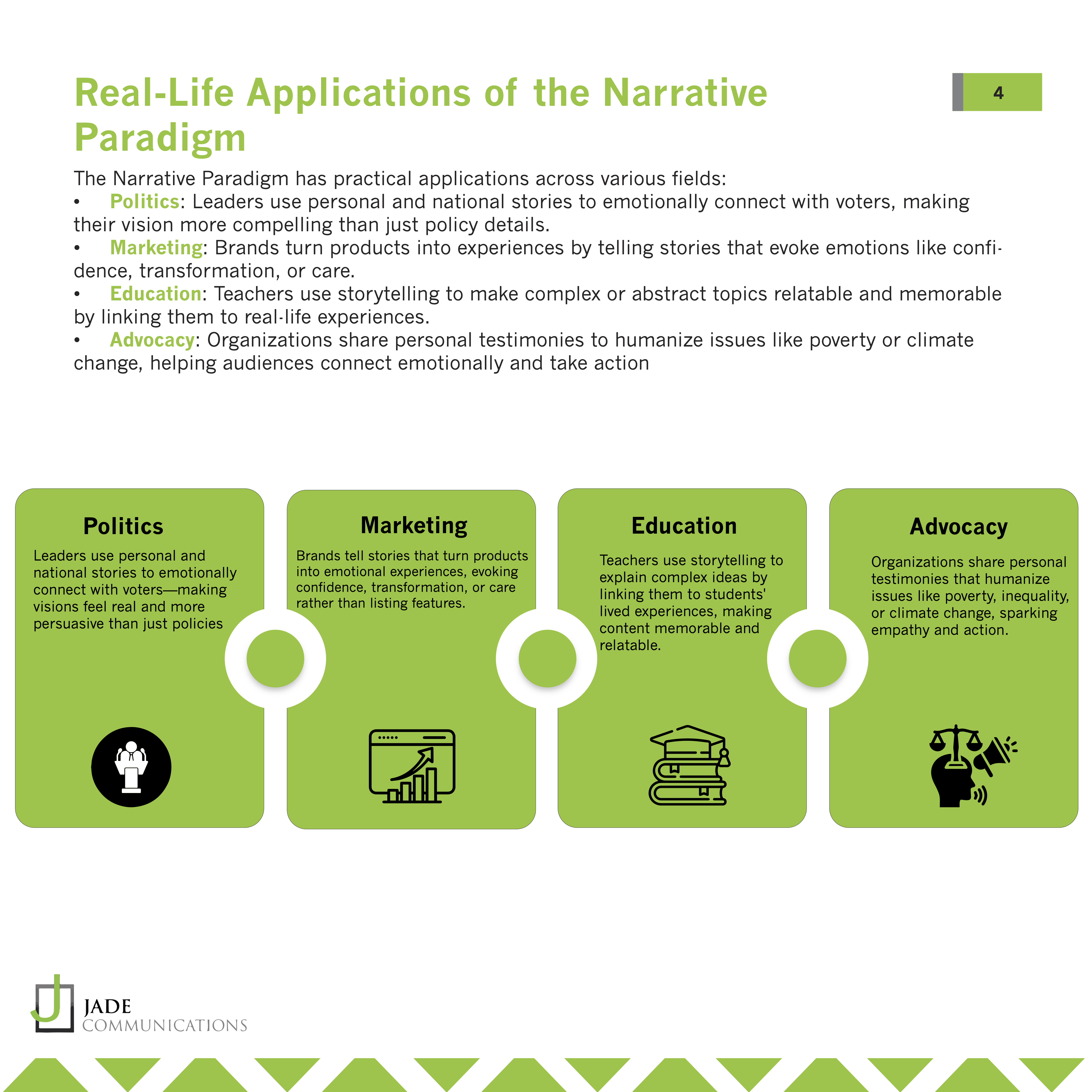
By Jade Communications“Stories are the most powerful way to put ideas into the world today.” - Robert McKeeEvery day, we are surrounded by stories. Some unfold around the dinner table, some scroll past us on social media, and some play out in classrooms, boardrooms, or even on campaign trails. These stories shape what we believe, influence our decisions, and connect us to others. Communication scholar Walter Fisher captured this phenomenon in his Narrative Paradigm Theory, which shows that storytelling is at the heart of all meaningful communication.What Is the Narrative Paradigm Theory?The Narrative Paradigm is a communication theory that proposes all meaningful communication is storytelling. It challenges the traditional idea that persuasion relies primarily on logic and structured arguments. Instead, Fisher argues that humans are natural storytellers.Rather than focusing solely on reason, facts, or evidence, Fisher introduces the concept of narrative rationality. People are not purely logical; we are guided by good reasons embedded in stories. These stories are judged on how coherent and relatable they are.To determine whether a story is persuasive or meaningful, Fisher identifies two key criteria.Coherence: How well does the story hold together internally? Is it consistent, logical, and believable?Fidelity: Does the story resonate with our experiences, values, and beliefs? Stories with high fidelity feel authentic and trustworthy, even without heavy reliance on statistics.Why does the Narrative Paradigm Theory Matter In communication?People don’t receive messages in a vacuum. We interpret and evaluate new information through the lens of the stories we already know, the lives we’ve lived, the values we hold, and the communities we belong to. Fisher’s theory offers several insights that apply across professional fields.First, everyone is a storyteller. The Narrative Paradigm democratizes communication by asserting that all people can create and interpret stories.Second, stories carry moral weight. Audiences evaluate whether a story feels “true” in alignment with their understanding of the world.Third, storytelling is strategic. Effective storytelling is deliberate. It involves structure, intention, emotion, and timing.Finally, emotion and logic are not separate. A story can simultaneously move hearts and also frame decision.Real-Life Applications of the Narrative ParadigmThe principles of the Narrative Paradigm are not confined to a theory; they are actively shaping real-world communication every day.In politics, leaders often craft narratives around their upbringing, personal struggles, or national identity to connect with voters on an emotional level. It’s not just the policies that matter it's the story behind the vision that draws people in.In marketing, successful brands use storytelling to turn products into experiences. A skincare company doesn’t just sell lotion it tells the story of confidence, transformation, and care, making the product feel like a solution to a shared human need.In education, teachers use storytelling to make abstract concepts come alive. A history teacher, for instance, may humanize major events by telling the story of one family or child who lived through them, making lessons more memorable.In advocacy, organizations share personal testimonies to draw attention to broader issues, like poverty, injustice, or climate change. These stories help donors, communities, and policymakers see the human face behind the statistics.How can You Apply Narrative Paradigm Theory?Though the Narrative Paradigm was born in academic theory, its real power lies in practice. You’ll find it at work in campaign trails, community meetings, boardrooms, classrooms, and even dinner table conversations. It reminds us that people connect with meaning.Applying the Narrative Paradigm means going beyond data to highlight human experience by sharing examples that feel personal and true. It means recognizing that how you tell the story and who tells it can be just as important as the story itself.What are the Benefits of Applying Narrative Paradigm Theory?Applying Narrative Paradigm Theory brings several benefits to communication by making messages more engaging, relatable, and memorable. Stories naturally capture attention and hold it longer than abstract arguments, allowing ideas to resonate on an emotional as well as an intellectual level. They build trust and credibility when they feel authentic. Narratives also make complex concepts easier to understand by framing them in familiar, human terms. In group or community settings, storytelling strengthens shared values and identity, creating a sense of unity and purpose. Most importantly, it inspires action, by helping people to see themselves within the story and feel part of its outcome. 
By Jade CommunicationsIt is a conference setting in the afternoon, and two speakers are scheduled to conclude the session. The first speaker walks onto the stage, fumbles with their notes, clears their throat nervously, stumbles through the first few sentences, and quickly rushes through their words.The audience, sensing the uncertainty, immediately disengages and endures the ten-minute speech. However, things seem to change with the last presenter, who takes the stage, smiles warmly, stands tall, and, within 30 seconds, has the audience leaning in, eager to hear more.The difference is in the first impression.In communication, regardless of the context, the opening moments carry disproportionate weight. Research suggests that people form impressions within 7 to 30 seconds, and once formed, those impressions are hard to change. This makes first impressions not just important, but decisive.Why first impressions matterFirst impressions set the framework for how everything else will be understood. The speaker who comes across as confident, prepared, and engaging from the beginning will likely influence the audience to stay attentive. However, a speaker who displays uncertainty will spend the rest of the interaction trying to overcome that initial impression. The way a speaker presents themselves in the opening moments creates a lens that influences how people perceive their message and credibility.Mastering body languageBeing intentional with body language is a powerful way to influence others’ perceptions, because the body communicates well before the mouth does. For instance, posture, eye contact and gestures reveal much about a person's confidence and credibility. While a slouched posture indicates insecurity, standing tall shows authority.Likewise, avoiding eye contact might indicate unease, whereas steady (but not staring) eye contact fosters trust. However, making small adjustments, such as planting the feet firmly, relaxing the shoulders, and using open hand gestures, helps create a strong presence.Owning your tone of voiceThink of tone as the emotional soundtrack to the message, because it adds emotional texture to words. Having a clear, steady, and energetic tone conveys confidence, but a flat or shaky voice signals doubt. To keep listeners engaged, it is advisable to vary the pitch, pace, and volume.Practical tips for a strong opening and nailing the first 30 secondsThe choice of words at the beginning is critical. An uninspired "Good morning, thanks for having me" will rarely leave a mark. Instead, opening lines should spark curiosity or connection. For instance, a relatable story can emotionally draw listeners in. A thought-provoking question can make them think and reflect. For example, beginning with "Did you know that most people decide whether they trust you in just seven seconds?" instantly grabs interest and sets the stage for your message.The first 30 seconds of any communication should never be left to chance. Planning them as carefully as the main points helps one begin with impact. Practising confident body language, standing tall, breathing deeply, and maintaining steady eye contact ensures your presence communicates assurance.Using storytelling strategically keeps your audience both emotionally and intellectually engaged. Matching your tone to the purpose of your message reinforces your credibility while keeping your opening concise and intentional, so you don't lose attention before you gain momentum.ConclusionFirst impressions matter not only in speeches but in everyday professional interactions. In a job interview, the way you greet the panel sets the tone for the entire session. Even in emails, the subject line and opening sentence decide whether your message is read or ignored. Thinking of every communication moment as a stage changes the way you approach it.The truth about communication is that people might forget the finer details of what you say, but they rarely forget how you made them feel, especially at the beginning. Those first few moments are your opportunity to establish credibility. Perfect your first impression, and you set the entire conversation up for success. 
The ability to be confident, comfortable, composed, and competent in various professional settings is a significant strength that gives an edge to the woman pursuing a professional career. This is especially so for women in leadership roles.  However, the environments they operate in are often challenging to navigate, especially in the absence of structured support systems to amplify these skills and improve their professional effectiveness.“Just how do I handle high-stakes engagements? Am I communicating effectively to influence outcomes? And what kind of leader am I, and how do I enhance my impact? Am I the only one experiencing this? ” These are among the common questions that women professionals grapple with regularly without definite conclusions and finding themselves in a continuous cycle of hanging critical questions!Personal agency in professional environment seriesTo help them find answers and support them in their professional journey, Jade Communication’s Centre For Applied Human Communication has partnered with the US-based Personal Agency In Professional Environments Series (PAPE), a Workshop and Cohort for Women Professionals in East Africa.Jade’s CEO, Paul Achar, lauds the partnership with PAPE Series that perfectly aligns with its Applied Human Communication model, which focuses on applying existing communication theory and research to practical situations that clients face in applied contexts.He says the programme aims to provide a safe space for professional women to enhance their personal growth and create communities that would achieve more significant impact, especially in empowering women.“ The reality is that PAPE provides an opportunity for professional women leaders from diverse fields, whose paths might have never crossed, to come together and form an empowered support community that will impact other women and create a ripple effect in society.” BE’s Associates Juliet Erickson, an executive coach, communication specialist and author and Maeve Richards, a diversity, equity and Inclusion expert and coach, are the programme facilitators.Juliet says: “When we researched and designed the programme some few years ago, our goal was and remains to create a space where women can flourish and transform and benefit from a stronger sense of self, clarity of purpose and confidence.”Programme StructureThe PAPE Series is designed to equip and enable women with varying capabilities. It focuses on individual strengths and needs to build professional effectiveness through skills development, practice and support from a generative community.It bridges the potential gap between an intellectual understanding of personal agency goals and their accomplishment. It is structured as a three-month series comprising ten weekly virtual sessions via Zoom, where two executive coaches meet with a cohort of six to ten participants.The PAPE Series employs a mix of skill-building lectures and facilitated discussions with recommended homework. In addition, participants can access curated resources, videos, white papers and studies, and one-on-one coaching calls if desired.The skill-building, cohort content and resources are tailored to the unique circumstances and common experiences that women in professional setups often share. Each session combines relevant discussion and skill development associated with real-world circumstances and upcoming situations.Skills building Some of the skills-building content includes a listener-centered approach to planning for high-stakes engagement, communication, presentations, negotiations, and conversations. Also, PAPE provides ways to “read” and respond to others and effectively understand your and their emotional and communication styles.Individuals are also taught techniques to enhance leadership effectiveness and “presence” when leading an effort, running a meeting, or giving and receiving feedback. Also tackled is dealing with confrontation to achieve better outcomes that create less friction and overcome resistance.Inner resilience development During the sessions, participants discuss their strengths, awareness of, sensitivity to, and what they experience in the professional environments where they want to excel. Participants explore their internal capacities and ability to remain calm and confident and engage in credible, competent, and composed ways. The primary goals are to recognize what is in their ultimate best interest and develop inner resilience. The focus on building up inner resourcefulness and resilience is to produce more constructive, positive, and purposeful responses.Participants form dyads. The dyad conversations and the sessions enable the participants to build a community of mutual encouragement, insight, and lasting support. Participants share strategies to leverage mentors, sponsors, allies, and cheerleaders. There is exposure to practices, such as affirmations, self-compassion, ways to calm, and grounding techniques.The programme culminates with an opportunity to step into the Spotlight to work on a live issue and receive ideas, feedback, and support from the Cohort. The learning arc is progressive and designed to educate, equip, enable and empower the participants accountable for their learning. They are encouraged to practice the skills, report to the Cohort, and leverage the Cohort to lock in the learning. In the end, participants experience personal and professional transformation evidenced in a more robust, purposeful and empowered sense of self. The increased effectiveness in influence in both personal and professional positioning leads to greater levels of credibility, trust, acceptance and respect. But perhaps the main highlight is the reality of warm and sustainable community support.Kenya CohortThe experience is evident from the first Cohort that went through the PAPE Series from October 2023 to December 2023. It brought together ten professional women leaders from diverse fields. Participant Ambassador Dr Josephine Ojiambo says of the programme: “ Women possess undeniably unique leadership styles as well as different yet complimentary professional and personal contributions to those of men. Acknowledging, affirming and adapting these women-centric contributions are central to the ten sessions PAPE training experience.”The registration is ongoing for the second Cohort, which will run from 26 February to 3 May 2024. 
2021 was the second year of the Covid-19 pandemic and some of the best communicators were medical practitioners whose excellent communication skills helped us navigate the turbulent year.This year brings into focus the importance of communication at an individual and corporate level and our analysis included some organizations who played critical roles during the pandemic and some which are going to be key in 2022 as the country enters its electoral season.As usual it is certain to generate robust debate and it is our hope that readers will use the communication takeaways and examples to grow their own communication skills.Best Communicators1.Dr. Loice Achieng Ombajo- calm, knowledgeable, connectingWhen a crisis strikes, true leaders emerge. At the height of the Covid-19 pandemic, one Dr. Ombajo, a physician and infectious disease specialist stood out. When so little was known about the new disease, she became a regular face on TV speaking to a panicked populace and providing insights on the transmission, management and prevention of covid-19.Her ability to simplify complex medical terms into easy to understand concepts while maintaining authenticity enhanced her connection with audiences. Her conversational cadence and calm mien provided assurance to a worried public being bombarded with scary news of a new disease.Even during animated prime time interviews at the height of the crisis, she remained unruffled, maintaining a faint smile that belied the weight she was carrying of advising the government and the entire health sector on pandemic response and management of Covid-19.Dr. Ombajo stands out as a professional who has mastered the art of deploying communication as a tool to advance critical messages in times of crisis. 2. Dr. Rose Mutiso- The communicating researcherDr. Rose Mutiso is not only an energy researcher, and co-founder of the Mawazo Institute but also a policy advocate on energy, innovation and environment.  Her ability to deploy logical appeals based on her research and incorporate strategic emotional appeals for her policy persuasion agenda is quite masterful.She has managed to escape from “the prison of technicality” that holds captive so many experts and to package and mainstream her technical knowledge into content for audiences lacking in her technical expertise. It is no wonder that Dr. Mutiso has some TED talks to her name; masterfully delivered as well.3. Justice Joel Ngugi-The Law doesn’t have to be complicatedThe “law is clear” is a cliché deployed by many legal practitioners right before they lurch into legal jargon understood by a very limited audience and judges are no exception. Prof Joel Ngugi is that rare judge who actually makes sure that the “law is clear by communicating his mastery of the law, articulately, calmly and with humble confidence.  The depth of his scholarship, understanding of the law and his delivery of rulings have been applauded by both winners and losers in his court. This year, his informative and persuasive media interview on Alternative Justice Systems was a masterclass on why the “law doesn’t have to be complicated.”4. Chief of Defence Forces (CDF). Gen Kibochi- authoritative communicationAt a time when the Kenya Defence Forces (KDF) has assumed a greater role and visibility in civilian and public life, running several critical institutions from Nairobi Metropolitan Service, Kenya Meat Comission among others, strategic communication has assumed a greater role in the military, a clear departure from the traditional secretive approach.Besides having a vibrant public affairs department and an active social media presence, KDF has gone ahead to launch the Strategic Communication Centre in recognition of the role information and communication plays in modern warfare and as a core element of national power.At the helm of this renewed communication, push is the CDF Gen. Robert Kibochi. While the CDF does not make many public speeches and appearances, the few times he has done so have stood out. He communicates with the confidence and authority that his office bestows.In Television interviews and public addresses, Gen. Kibochi comes out as clear minded, reflective, deliberate, and authoritative.  One can feel the force of his words as he speaks giving the impression of a man in charge. His unique communication abilities will prove useful in the increasing civil-military engagement. He should speak more.5. CAS Mercy Mwangangi- graceful under pressureIn the midst of the Covid-19 Pandemic the daily briefings by the Health Cabinet Secretary had become predictable and audiences were no longer actively engaging. The emergence of the Health CAS’s eloquent, measured presentations offered a refreshing messenger to a public that was pandemic weary.Dr. Mwangangi’s strength lay in her ability to effortlessly communicate science and policy in her twin role as a health professional and policy maker in the Ministry of Health.  Her calm presence combined with the candor and thoughtfulness with which she handled questions from journalists certainly helped to educate and allay public fear about the disease.6. Dr. Gitahi Githinji- simplifying the complexThroughout the Covid – 19 pandemic when facts, science and truth have mattered most, Dr. Githinji Gitahi has been a constant face and voice on Television and twitter providing deep insights to help Kenyans navigate through the pandemic.Nicknamed everyone’s ‘favourite doctor’, the articulate doctor has taken on the role of a public intellectual, expertly simplifying the science and making it interesting for the ordinary folk. His TV appearances which have endeared him to the public have been a welcome break from the usual political diatribe as he educates people on various public health issues like vaccines, healthy lifestyle among other topics. Dr. Gitahi effectively uses social media especially his twitter handle @Daktari1 to educate the public and advocate for public health issues like access to vaccines.7. Kwame Owino- economics for all not just for someKwame Owino is an economist who has managed to introduce economic theories and practice to a mainstream audience in a language they can comprehend. By effectively using communication techniques like storytelling, and imagery, his economic explanations come to life.Human beings can get intimidated when presented with huge numbers and the challenge for communicators lies in humanizing these numbers and presenting them in chunks which are easy to understand and process; a skill Kwame has mastered.His audience analysis skills are well honed, and his passionate speaking technique and good listening skills make him a favorite of public debate forums.8.Khalid Hussein – authentic advocacyKhalid Hussein possesses that quality of authenticity and when he communicates he does come across as genuinely concerned about the causes and the people he advocates for.A Human rights crusader who emerged on the scene years ago as a defender of the voiceless especially victims of profiling he has continued to grow in his ability to not only frame perspectives through the legal prism but to also present his causes as social and political concerns that affect the greater society not just the victims.His verbal ability to infuse human rights issues even when a discussion is not focused on the topic affirms his standing as a good communicator and defender of human rights.He has mastered the vocal aspect of communication and uses his voice to effectively project calmness even under pressure or while speaking on controversial issues. Whenever he has appeared on a scene of human rights abuse, his transparent, compassionate and authentic manner has ensured he connects with audiences listening or watching him.9. Waihiga Mwaura- integrity, competency exemplifiedThe four – time award winning journalist has a conversational, likeable manner and when he conducts interviews, he shows that ability to balance depth, fairness, firmness, and respect for his interviewees and audience.He made the headlines when he became the subject of the news himself during the trial in the Rio Olympic scandal. His testimony in court was crucial in the eventual convictions of top officials from the Ministry of Sports and the National Olympics Committee of Kenya (NOCK) and the resultant coverage presented him as a person of great integrity.One of the key attributes of communicators is credibility and for Waihiga his credibility was greatly enhanced by his ethical conduct. Integrity combined with competence communicates and connects with audiences; and it certainly helps when these qualities come from a newsman whose currency of trade is trust and believability.10. Susan Silantoi- graceful, sincere communicationSusan Silantoi’s ability to communicate public policy in a reflective relaxed conversational manner won over many viewers to her podcasts and ensured she was also invited on various media platforms to present her perspectives.A core aspect that connects audiences with communicators is the ability to project goodwill by showing that one has the audience’s best interests at heart and Ms. Silantoi managed to do this so well and came across as the “public’s teacher” on policy issues. Her systematic communication style proved to be an asset and she seems to have also mastered the optics and staging for good presentations.Worst Communicators and Moments1.Prof. George Magoha-lacking in connectionThe Professor of Surgery is known for his brash no-nonsense approach to issues that has seen him nicknamed the bulldozer. In cartoons, he is often depicted as an angry charging bull to symbolize his penchant for taking on issues and people head on, woe unto you if you stand in his way.This is reflected in his communication approach that is often combative. Most times when the Education Cabinet Secretary was speaking, he was either ‘telling off’ people, ‘putting people on notice’ ‘warning people’ or ‘issuing threats’ mostly directed to students, teachers, parents or unions.Unfortunately, this kind of communication is rarely effective, the old mantra is don’t issue threats unless you intend to see them through. People soon become desensitized and ignore the threats as empty rhetoric. Few people can remember anything notable the CS has said of late meaning his messages are not getting through. The CS would be better served by taking a more persuasive and consultative approach.2. Nick Mwendwa- not ready for the game?Since taking over the helm of the Kenyan Football Federation (KFF), Nick Mwendwa has been a disaster both on and off the field. He has overseen plummeting football standards in the country with Kenya consistently falling short and missing out on international competitions.It has been argued that the greatest injustice you can do to Nick Mwendwa is to thrust a microphone in his face. His high-pitched voice, combined with an arrogant and reckless delivery has seen him misspeak severally especially when riled up with an issue. He seemed to lack a strategy for his press interviews thereby making him gaffe prone, which eventually alienated him from crucial allies and led to the loss of confidence by key football stakeholders.For instance, when he attempted to defend the appalling losing record that saw Harambe Stars recently drop out of the Word Cup qualifications. Mwendwa decried lack of genuine quality and talent within the Harambee Stars squad, never mind that it was part of his job to create systems that identify, nurture and deploy that talent.3. Hon. John Njuguna Kawanjiku- unprepared, incoherent communicationThe newest member of the National Assembly was elected in very contested election and his branding as the common person’s representative seemed to resonate with the people of Kiambaa Constituency.His parliamentary speeches would therefore be highly anticipated and many expected him to use the elevated parliamentary platform to articulate his agenda and what his election stood for especially in the current political ideological debates.He went ahead to deliver a poorly crafted, barely coherent and ill delivered speech. At such a pivotal moment instead of rising to the occasion, and using the platform to elevate his credibility and pass across some core messages which would cement his ascendancy into national office, he stumbled. His poor delivery transformed him into a bumbling caricature thereby diminishing his credibility.4. Pastor James Ng’ang’a- vulgar Inappropriate contentPastor Nga’nga makes an appearance on the worst list again. Vulgar content in his sermons got him banned for six months from broadcasting by the Communications Authority.While we are guaranteed constitutional freedoms of expression, whenever we choose a mass broadcast medium to spread our messages, the Media Council spells out clear guidelines on what is appropriate mass broadcast content.And while as a society we must collectively refuse the “cancel culture” we should also ensure that the content broadcast on mass media does not infringe on other’s rights especially when they do not have a similar platform to defend themselves. Hopefully in six months’ time Pastor Nga’nga will have “cleaned” up his sermons.5. National Police Service- uninspiring communicationThe National Police Service (NPS) struggled to communicate its enforcement role effectively during the pandemic period with its subsequent lockdowns and curfews.Its initial communication efforts were based on threats of forced enforcements and characterized by the abuse of fundamental rights while completely failing to express a more compassionate security model to citizens whose lives had been devastated by the pandemic.It was not clear if the NPS’s communication efforts were guided by any strategy but their security operational tactics seemed Ad hoc, reactive and clearly devoid of proactive security communication. The result was a rise in public resentment towards the NPS.As the pandemic continues and the country moves towards the 2022 elections, the NPS, and its leadership has to ensure that they communicate effectively. Some core messages they must broadcast to the public should be a focus on competency in executing their electoral security mandate, non-partisanship, a high fidelity to the law, and responsiveness to any security threats.During the electioneering period, they must strive to build trust with citizens by communicating concrete administrative and operational aspects that respect and uphold the rights of citizens.   6. Judicial Service Commission-failure to communicate outside the “bubble”The JSC while a traditionally insular institution, handles matters of high importance to the public. For the public to have confidence in the judicial services, the institutions must be undergirded by the ideals of integrity, fairness, and ethical conduct by judicial officers.These ideals were tested and found wanting whenever members of the public raised questions on integrity and also complained about some judicial officers.While the JSC might have internally invoked its processes for dealing with such complaints, it failed to inspire confidence with the public by not communicating in a clear and timely manner on the procedures it had instituted to deal with these complaints.The JSC must deliberately become more transparent and communicate to the public whenever there are complaints about judicial officers. Only by demonstrating that the administrative and operational processes it has in place to deal with ethical complaints against judicial officers, work will public confidence in the entire justice chain be enhanced.7. Independent Electoral and Boundaries Commission- non-strategic disjointed communicationThe IEBC umpired a number of by-elections in 2021, which revealed that the commission has not learned any lessons from the past. The commission was involved in reactive communication as opposed to proactive communication and even as they reactively communicated it was not clear whether the tactics deployed were anchored in sound strategy.The IEBC needed to raise its credibility which is still viewed through the lens of history in which both the elections winners and losers have raised administrative and operational questions that need to be answered.It did not vividly explain the entire electoral process (especially on the contentious dimensions) and how it has learnt from history. It also failed to use the power of strategic communication to explain to the Kenyan voter the administrative and operational processes it has put in place to bolster confidence in its role as the electoral umpire.Its approach was mainly tactical with a focus on the day-to-day, keen to try and create a good image but failed to connect these efforts with the bigger picture which was ensuring its credibility will be beyond reproach even as the nation moves into the next general elections.8. Wafula Chebukati – uninspiring, lacking in confidenceCommunication is not just about the words spoken by individuals; it also involves our non-verbal cues. The IEBC chairperson has been in office for more than five years but does not seem to have grown his communication skills.During presentations it was unclear if he had a good communication strategy in place and in many instances, he was uninspiring, devoid of passion, spoke in a monotone and his non-verbal cues did not complement the message. He lacked the leadership communication skills of confidence, clarity of communicating vision and the skillful attainment of it, likeability and believability.As one of the most important persons to watch in 2022, Mr. Chebukati must know that from the start of the year, his public appearances will be scrutinized. He must put in place measures at the IEBC that demonstrate competence, fairness, non-partisanship, and utmost integrity and communicate the same to the Kenyan public with great skill to inspire confidence.9. Growing pool of public intellectuals- “A jack of all opinion; diminishes credibility”The continued expansion of media has introduced Kenyans to a new category of analysts and experts branded as “public intellectuals”.While these persons are key to enhancing our fundamental freedoms of expression, in some of their media appearances some have proffered opinions outside their realm of specialties and expertise while presenting them as absolute truths and not merely opinions to instigate crucial debates. Some of these opinions have at times been challenged by the real experts in those specialties.While some of the public intellectuals have welcomed debate on their assertions, others when challenged on their assertions even when they are clearly out of their depth have resorted to deploying “educationism” (which is discrimination towards those they perceive to be less educated) as a defense to being held accountable.In 2022 the media and conveners of public forums would do well to not only encourage the growth of public intellectuals and the debate of ideas, but also hold to account these experts by inviting and offering platforms for their peers to fact check and review their public assertions.10. Dunstan Omari-  aggressive communicationDunstan Omari is a legal practitioner who enjoys the limelight and has been known to leverage on the power of media to communicate his agenda in a bid to shift perceptions on matters he is litigating. He appeared on media repeatedly as he filed numerous petitions against the Director of Public Prosecutions with the Public Service Commission. His statements while filing the petitions against the DPP became increasingly pugnacious, his tone and demeanor were angry and this performance robbed him of any semblance of professional objectivity.The high drama expressed with his aggressive communication proved that the personalized verbal attacks and contemptuous non-verbal cues can serve to alienate the very people one seeks to influence.This article is by Paul Achar, Executive Communication Coach & Applied Human Communication Practitioner at Jade Communications Ltd and Dr. Sam Kamau, a communications scholar, and tenured Lecturer at Aga Khan University
The Ladder of Abstraction is a theory that was created and presented by linguist S.I. Hayakawa in his 1939 book “ Language in Action.” It basically describes the way that humans think and communicate in various degrees of abstraction.Professionals are called upon from time to time to make presentations to Audiences that may lack their technical expertise to persuade them on a particular course of action. Understanding the concept of the Ladder of Abstraction is critical to making great presentations that ultimately connect with these audiences.A ladder presents the perfect imagery for this concept. Like the ladder rests on solid ground, the bottom of the ladder of abstraction represents concrete things or ideas. The Middle of the ladder represents things or an idea that not entirely concrete, and yet not completely abstract, while the top of the ladder represents abstract ideas or concepts.It is of the essence that public speakers avoid what in speech-making we call “dead level abstraction” which is speaking at one level of abstraction and not oscillating between the different levels. Good Speakers realize that Audiences need both concrete details and abstract ideas in order to make a strong persuasive argument. Major Speeches like Martin Luther King’s “ I have a Dream”, then Senator Barack Obama’s speech on race, and Steve Jobs launch of the Iphone were able to move up and down the ladder making the audience more receptive of their message.Nancy Duarte an authority in the Structure of great presentations has done groundbreaking work in articulating the structure of some of history’s greatest speeches and her narrative alludes to the speakers avoiding “dead level abstracting” and greatly connecting with their audiences.Conducting a comprehensive Audience Analysis as a part of speech preparation helps speakers to determine how to create a perfect rhythm, that balances between various levels on the ladder of abstraction and know from which point on the ladder to begin and end their presentations.You can find more information on the Ladder of Abstraction using the following linksAndrew Dlugan, “The Ladder of Abstraction and the Public Speaker.” September 15th 2013 Available on http://sixminutes.dlugan.com/ladder-abstraction/#more-8707Nancy Duarte, “The Secret Structure of great talks.” November 2011, Available on http://www.ted.com/talks/nancy_duarte_the_secret_structure_of_great_talksHayakawa S.I. and Alan R. Hayakawa, Language in Thought and Action (Plymouth; Mcneil, 1991), 85-95
A mile above sea level, the thin Mombasa air refreshed delegates representing the governments of Rwanda, Kenya, Burundi and Uganda as they congregated to hammer out a plan to launch the Northern Corridor Transit System. The year was 1981 and the first inter-state meeting in August resolved to adopt a study report sponsored by the European Economic Community (EEC) to establish the Northern Corridor Transit System in the East African Region. The same report also contained 23 recommendations to ease the flow of transit traffic in the northern corridor.The Northern Corridor Transit System was to include road, railway an oil pipeline as well as water transport system between these states and would ease the transportation of goods and people from Mombasa to Bujumbura through Kampala, Kigali and continue on to Beni through Bukavu, Goma in the then Zaire now the Democratic Republic of Congo. In November 1985 another meeting was held in Nairobi in which the state parties agreed to establish the Transit Transport Co-ordination Authority (TTCA) and form a permanent secretariat to assist the TTCA in ensuring an effective implementation of the NCTA, with a permanent secretariat finally being established in Mombasa in October 1988. During the meeting in Kinshasa, Zaire in 1989 the member states agreed to meet in Mombasa in 1990 to discuss recommendations for removing the non-physical barriers to traffic flow.Fast forward to June 2013 in Entebbe, Presidents Uhuru Kenyatta (Kenya), Yoweri Museveni (Uganda), and Paul Kagame (Rwanda) met to discuss how to co-operate and speed up development in the region and of great concern was the period it took to transport cargo from the Mombasa Port due to various bottlenecks along the way. The Presidents agreed that this transit period needed to be reduced and the infrastructure along the corridor needed to be improved to ease this period and the construction of a new Standard Gauge Railway (SGR), a common crude oil pipeline and the reduction in the cost of doing business in the region had to be brought down.The result of this meeting was the renaming of The Tripartite Infrastructure Initiative to the Northern Corridor Integration Projects (NCIP) with South Sudan incorporated as a member and the decision to simplify immigration laws in the region and enhance cooperation on tourism, trade and services with each country establishing a special office to coordinate the NCIP with the Presidents committing to meet every two months as a follow up.The history of the project puts into context the role Communication has played and will continue to play in ensuring its success. When the Project was first conceptualized in the Eighties, it was the era of centralized Communications, a period where sending a fax to newsrooms disseminating information regarding the State Parties meeting and getting it broadcast on the sole state broadcasters or the tightly state regulated newspapers was adequate information, but in 2013 the communication scenario was different; the modern media cacophony heralded great promise but also posed some challenges. To put it in greater context the rise of citizen journalists and Social media platforms presented a great opportunity for communicating diverse aspects of the NCIP while the challenge of various communication mediums was that of message contextualization in view of the diverse audiences who needed to know about the projects.Communication Critics of the earlier era when the project began in the Eighties, have pointed out that the centralised and tightly controlled government communication of that era may have resulted in fewer East African Citizens becoming aware of the projects and hence the resultant limited buy-in and ownership of it; but the same critics are pointing out the fact that regardless of the opportunity presented by the rise of various communication mediums in 2016, similar limitations of effective communication about the project may hinder its successful implementation. The communication efforts for the Northern Corridor need to be more robust and strategic in the following ways:First we must raise the general awareness of the project and the opportunities available for diverse stakeholders. A quick survey will reveal that despite a lot happening in the various project implementation phases, the general awareness of its scope by citizens in East and Central Africa is very limited. A robust Integrated Communication Strategy, that is multi-disciplinary and capable of being deployed on multiple fronts to push key messages regarding the Northern Corridor process, is necessary. The strategy must be geared towards enhancing awareness among Citizens , Investors  and the Business Community among others. Secondly it should be geared towards inviting interested stakeholders to be a part of the project and to “own” it, and finally it must ensure timely information dissemination that keeps the stakeholders aware of every step of its implementation.The Northern Corridor Project also requires Credible Message Surrogates. A keen observation on the interplay of the Northern Corridor’s current communication Strategy, messaging and Audiences, reveals that the major communication efforts have continued to be anchored around the regional Heads of State and becomes more pronounced during their review meetings. The current strategy has neglected a key approach of strategic communications, which is about drawing from the different institutional resources within the region to create a team of credible message surrogates to push the communication agenda of Northern Corridor Project. The Message Surrogates need to be profiled against the targeted audiences and the persons with utmost credibility deployed bearing key messages on the Northern Corridor project.Finally Good Messaging is of the essence. A Clear messaging gap has been evident. The Northern Corridor message should be simple, concise and easy to understand among the various targeted audiences. A simple survey currently reveals that not many “targeted” stakeholders are aware of various aspects of the project. Perhaps a more decentralized message generation structure that considers the diversity of the countries involved in the Northern Corridor Project needs to be implemented.
We are in the age of Communication and those who communicated effectively greatly increased their influence while those who failed ended up losing credibility and goodwill. This year’s list was compiled with the help of persons outside the formal practice of Communication who utilised Social Media and popular online survey platforms to submit their nominations. The list is diverse and uses specific examples and tangible takeaways; hopefully readers will use it as a teaching moment and pick lessons for their own use.Great Communicators analyse and understand their audience then craft and creatively deliver pertinent messages, which connect with the Audience. Most of the times they receive positive feedback expressed through the audience engaging in a desired course of action and even when an audience disagrees, great communicators will have gained enough goodwill for the audience holding opposing views to give consideration to their propositions. In 2015, the following persons epitomized the attributes of Credibility, Authenticity, Great Delivery, Deep Knowledge, Likeability, Humility and Passionate Delivery that makes for great communicators.Best Communicators1.Foreign Secretary Amina Mohammed- Firm Versatile DiplomacyKenya’s Top Diplomat tops the list this year, and rightly so. She has been the epitome of consistency and versatility when addressing diverse audiences and above all manages to always be On-message.Madam Amina displayed that rare ability of being able to communicate a strong point of view even to opposing audiences without condescending or becoming a polarizing figure. Her ability to internalize key messages and move beyond written talking points to extemporaneously deliver articulately, no doubt makes her a great communicator. She was clearly a lady in Charge and effectively deployed her communication abilities to back her up.2.President Barack Obama- Inspirational, Aspirational ConversationWhen Air Force One landed at the Jomo Kenyatta International Airport and President Obama jogged down the long stairway, much scrutiny would be on his Verbal and Non-Verbal Communication during his tour. The First African American President who traced his roots from Kenya was in a sense “coming home.” His tour was carefully themed as “a focus to the future as opposed to the past” and by the time he stood up to speak to the Kenyan People on his final day at the Safaricom Indoor Arena with a youthful audience in attendance this theme became more evident.Great speeches usually have a common characteristic; the moment they are delivered may be fleeting, but they have a transcendent quality about them and become a part of conversations in years to come. This was one such speech; particularly because in addition to the historic nature of the speaker, the themes of a shared Hope and National Unity, which transcend the current myopic obsession with tribal identity, will have an enduring resonance in Kenya’s future and will continue to be central in our quest to build a more perfect Nation.In its final iteration President Obama’s speech to the Kenyan people wove together the threads of his father’s roots, his own journey, American and Kenyan values, aspirations of the Kenyan people and his desire to use his words to shape the perception of Kenya’s present reality into a new reality based on his sentiments that all Kenyan’s shared a common destiny. The speech was a masterful fusion of substance and great delivery connecting with the Kenyan people and he was able to speak hard truths without appearing patronizing to his host the Kenyan President and the Kenyan public. (A comprehensive Analysis is available and will be made public on my blog www.paulachar.wordpress.com)3.Pope Francis- Humble, Firm Compassionate DeliveryWhen the plane christened “Shepherd One” landed in Nairobi, Kenyan’s were formally introduced to Pope Francis’s Considerate Communication Style. He displayed great humility, exhibited good knowledge of the country and its challenges. (A clear indicator that he had read and internalized his briefs). His tour was designed to fit with his overall agenda of accessibility to the least among us and it was no surprise that he declined any lavish state dinner, avoided a huge motorcade and even carried his own bag.This was all communicating who he is and what he believes in. When he stood to deliver his sermon or speak to the youth, his considerate conversational style and manner combined with a bold message on social justice appealing to the better side of Kenyans was proof that you don’t have to raise your voice to communicate and connect. His emphasis on humility, concern for the poor and interfaith dialogue was well communicated in the stagecraft and message of his tour.4.President John Magufuli- Authentic and PassionateWhen the Tanzanian Governing Party Chama Cha Mapinduzi (CCM) nominated Dr. John Magufuli as its Presidential Candidate it came as a surprise to many. How would a party insider distinguish himself from the incumbent and authentically position himself as a change agent? When he eventually hit the campaign, his stump speech was a masterful fusion of a change message, hopeful future and a promise to break from the past. His authentic passionate delivery backed up with a narrative of his hardworking scandal free public service track record greatly enhanced his credibility.His Direct Communication Style, message and passionate delivery made him appear like an insurgent leading an uprising from within the CCM and his slogan “Hapa Kazi Tu” (All about Working) elevated him to the Presidency. His actions and communication since the start of his Presidency have been consistent with his Anti-Corruption and “Hapa Kazi Tu” slogan. His first address to parliament will go down in history as a great speech. It was Direct, Authentic and Passionate while clearly articulating the scope of his Administration’s Agenda and we also learnt that he is good with the Teleprompter. His influence on the African continent is certain to grow in coming years.5. Ms. Amina Hashi- Young, Knowledgeable and Confident CommunicatorIf you have never heard of this young Land Law Expert, well, make sure to look out for her in the coming year. She is clearly a great legal mind who combined good communication abilities with deep knowledge on land issues to curve a niche and despite of her relative youth has achieved quite a lot. Amina easily uses her Systematic Communication Style to speak with authority, while deploying an expressive voice that makes you want to listen. Her ability to synthesize and simplify complex legal land issues and communicate the same to audiences, which may lack a legal background, is the stuff good communicators are made of.6.Dr. David Ndii- Transforming Complex to SimpleGreat Communicators possess is the ability to transform complex concepts or subjects into simple to understand messages. This Rhodes scholar and Eisenhower fellow who holds a Doctorate in Economics from the University of Oxford has managed to break free from the “experts curse.” (This is when experts deploy technical esoteric language, which a majority fail to understand).His opinions may be controversial as evidenced by the animated debates, his talks or writings evoke, but even his critics admit that he has effectively been able to break down economics into a simpler to understand subject for the mainstream. Combine the fact that he is a passionate speaker, who uses techniques like stories and imagery to pass across his message and you can bet audiences keen to listen to his presentations will certainly grow in 2016.7 Inspector General Joseph Boinett – Articulate, Systematic Steady under PressureProfessional and Credible Communication is of the essence when it comes to a Country’s Security Communication. Historically the appointees to the Chief of Police position in Kenya have been poor Communicators with few exceptions like the Former Police Commissioner Gen. Ali. The nomination and eventual confirmation of Inspector General Joseph Boinnet introduced Kenyans to an IG who was articulate and for the first time in the country’s history clearly articulated his agenda for the service as that of Building a People Centered Police Service during his parliamentary vetting process.Since assuming office his confidence in his communication ability has steadily grown as evidenced by his Town Hall meetings across the country and in subsequent media appearances.The Country has faced various security challenges and it has shown that speaking on behalf of the Police Service requires a high degree of Confidence, Steadfastness under pressure, Knowledge and the ability especially in the midst of a crisis to balance between bravado and reality, something the IG has managed. His Systematic Communication Style evidenced in his measured delivery proves that you don’t have to be the loudest to be effective. Hopefully in 2016, the Inspector General will deploy his communication abilities to speak with Kenyan’s more regularly even when there is no crisis.8 Charles Kanjama -A Compelling ,Versatile and Engaging SpeakerIt is not everyday you come across a lawyer who can quote Shakespeare, St. Augustine of Hippo and Pope Francis in one sentence while analyzing and trying to give sense to current affairs. Charles a lawyer, writer and Speaker is a spirited communicator who uses Stories, Analogies, References, Humor and Synthetic Parallelism to make his analysis or speeches come alive. His ability to analyze and synthesize diverse subjects into coherent narratives deployed in a steady expressive voice makes him a great communicator.9 Ms. Anzetse Were- Great Delivery (Mastery of Content and Language)Anzetse is a Development Economist and also the author of “Drivers of Violence: Male Disempowerment in the African Context”. She has been able to masterfully combine her work in gender programming and her economic consulting with a great ability to communicate.Her ability to mainstream her economic analysis to diverse audiences and to articulately frame her positions while deploying supporting evidence made her one of the most recognisable economists on current affairs programmes. In her economic analyses and dispositions, she came across as personable and objective, using each speaking opportunity or media appearance as a moment to instigate debate.On matters of gender programming and rights advocacy, her Direct Communication Style can be termed as Hard-hitting yet bearing compassion and is non-condescending. Anzetse is an articulate analyst who has certainly helped to bring back proper diction on Television debates.10. Police Spokesman Charles Owino- Steady, Calm CopThe Kenya Police Spokesperson's office in recent years had lost its credibility with its majority Audience; the Kenyan people. A Police Spokesperson’s role is to articulate to the public matters security and it requires the holder to exhibit a high level of knowledge on technical security matters, possess great communication skills ultimately enhancing their credibility and generating goodwill for the National Police Service. The recently appointed Spokesperson Charles Owino was articulate and proved himself a master of plain talk which audience’s liked about him.He proved to be a master of the Visual, Vocal and Verbal aspects of delivery. His understanding of the visual aspects of communication and mastery of the stagecraft of presentation saw him deploy good posture, a compelling demeanor, good dressing, the ability to command attention, great eye contact and utilized appropriate authoritative and confident gestures. Winning over the public is still a major task for the Kenya Police, and for the Police Spokesman who derives most of his influence right now because of his position, we would hope that in the coming year he effectively moves from “Position Power” to “Persuasion Power” in his communication with the public.Worst Communicators1.Heshan De Silva- Poster Child for inconsistent Narratives and loss of CredibilityHeshan burst onto the public scene billed as a venture capitalist and young billionaire who had overcome drugs and depression while on his journey to success. It was a good story delivered masterfully and combined with powerful motivational anecdotes, he was soon all over our television screens and eventually joined the lucrative paid speaking circuit commanding six figure-sums per speech.The curtains fell on this act when a single email from the PR Company managing him dissociating themselves from him and openly questioning the credibility of his narratives was sent to newsrooms.This email eventually led to a greater scrutiny of his story and the glaring gaps in the “success narrative” continued to grow. Some commentators claimed that he had lied and demanded proof of his multi-million-business empire but his responses only raised more questions than answers.Instead of deploying his speaking skills to respond, he simply posted a vague response on Social Media, closed all his Social Media accounts and pulled a Houdini. Well, as the year draws to a close, the possibility of multiple lawsuits by some of his past paid speaking clients is becoming common talk. The entire Heshan De Silva experience affirms the old adage that no matter how gifted you can communicate, without character and integrity it is all a house of cards and eventually when it crumbles the loss of credibility is something difficult to recover from.2. Hon Moses Kuria- Arrogant and grossly Inappropriate CommunicationThe Gatundu Member of Parliament epitomizes the fact that irresponsible, inappropriate communication coming from an elected leader can destroy a reputation. As he continued to fight charges of hate speech, he also embarked on a media appearance circuit in which his hubris, unrepentant, bloviating and arrogant disposition crowned him the villain among elected Kenyan politicians. To cap it all, it couldn’t get worse than when Hon. Kuria walked out of a live TV interview protesting some tough questioning.3. George Aladwa- Confrontational, Hostile CommunicationThe Former Mayor of Nairobi may not hold any elected office these days, but his influence as a leader demands that his communication is beyond reproach. His confrontational hostile words uttered at a public rally have ensured that he is also fighting charges of hate speech.Responsible Communication by political leaders demands that they must continually conduct a wide audience analysis which not only focuses on the situational context but also the entire national context in order to frame a message which will not be deemed inappropriate when viewed from the wider context regardless of the cheers it may elicit within the immediate context. His continued pompous style has ensured he advances into 2016 with huge legal fees.4. Treasury Cabinet Secretary Henry Rotich- Uncertain, Negative Non Verbal CommunicationTreasury Secretary Henry Rotich’s uncertain, wavering communication style failed to inspire confidence this year. While The National Treasury faced numerous questions, which required robust, credible responses from its Chief Executive, his public speaking performance was largely unsatisfactory. He may have deployed colorful graphs and Charts (Visual Aids) but he failed to elevate the level of his rhetoric by moving beyond the prepared talking points and expressing seamless extemporaneous deliveries.The Cabinet Secretary has a natural likeable demeanour but when under pressure he revealed negative Non-Verbal cues from closed and defensive hand gestures, limited eye contact and the all to common nervous body shifts, which were clear negative behavioural giveaways. In the coming year, the Cabinet Secretary must invest more time in preparing for any speaking engagements, his Verbal and Non-Verbal Communication must also be in congruence especially if he wants his audience to trust that he has nothing to hide.5. Presidential Strategic Communication Unit (PSCU)- Un-strategic Disjointed CommunicationStrategic Communication within the context of governance can be defined as infusing communication efforts with a clear Policy agenda and master plan or the deliberate orchestrated use of channels of communication to move and influence policy or promote an administration’s agenda.So why did the Presidential Strategic Communication Unit (PSCU) engage in Un-strategic seemingly disjointed communication? Some of the reasons can be found on this article using this link www. https://paulachar.wordpress.com/2015/04/13/two-years-on-why-has-jubilee-struggled-in-strategic-communication/.The PSCU may have got some things right, but their public messaging strategy required more refining and simplicity. At times the Bullet Point, Colourful graphics themed messages were above two levels of abstraction and in some instances extended to three. The cardinal rule of Mass Public Communication is that you cannot go beyond one level of abstraction in your messaging. To break it down further, the majority of the public needs to understand the message without thinking too hard. Anything beyond one level of abstraction is geared towards a minority who possess technical competencies in that particular subject. To succeed in 2016 the PSCU must move beyond controlling the 24Hrs news cycle to a more strategic approach that anchors its efforts on the bigger picture but maintains simplicity in messaging.6. The Elite Kenyan Athlete-Poor Pre and Post Race InterviewsPic. Courtesy of www.mylesedwards.wordpress.comThe race is coming down to the wire, and up ahead the ultimate price looms. With history beckoning another Kenyan athlete gradually pulls ahead and crosses the finish line securing yet another win for Kenya. Then comes the moment many are awaiting; a chance to speak to the world and frame their victory in a manner only champions can do. The interviewer asks questions and the Kenyan athlete struggles to frame a coherent, articulate response.This scenario was replicated numerous times in 2015 when Kenyan athletes won races worldwide.The inability to effectively communicate has locked many Kenyan athletes from the numerous opportunities that athletic stardom accords others especially their competitors from the Western hemisphere. Some of these opportunities come in the form of corporate endorsements, paid sponsorships to serve as spokespersons for various global causes and of course highly paid speaking engagements. Considering Kenyan athletes will continue to dominate the tracks in 2016, this current state of affairs needs to change; it’s of the essence that the athletes improve on their communication skills.
As 2019 ends and the world welcomes a new decade, the role of effective communication cannot be understated. In the next decade, effective communication will be the fuel that powers individuals and organisations to the next level.This year our Best and Worst Communicators list not only focuses on individuals but also incorporates communication moments for organisations.In compiling the list, we limited the inclusion of politicians who have hogged previous years. There is a big wide world outside of politics and it also revolves around communication. The list is bound to generate debate, but readers should use it as a learning opportunity and deploy the lessons therein.Best Communicators1. Prof. Kalamagamba Kabudi- Masterful, Powerful DeliveryFew Kenyans had ever heard of Tanzania’s Foreign Minister Prof. Kalamagamba Kabudi until he delivered the keynote address during the launch of the Building Bridges Initiative Report at the Bomas of Kenya. When he began his address, his powerful booming voice immediately captured the attention of the audience and in his introduction; he masterfully merged Swahili and English languages while using the rhetorical devices of rhyme and repetition to capture his audience.It was clear he understood his audience well, and the content of his message resonated deeply with them. He may have sounded professorial at certain points and he could have done well to shorten his twenty-four-minute speech but it had been long since a politician delivered such a captivating address within the Kenyan context.The Takeaway is that good communicators, will conduct audience analysis prior to their presentation and customize their address to connect with the audience. They also work on their voice which is the primary tool of delivery and it certainly improves the impact of a speech when a presenter deploys rhetorical devices. Prof. Kalamagamba Kabudi’s use of imagery, analogy, amplification, story-telling and parallelism showed that even in political set-ups a good communicator is still appreciated, but also served to challenge Kenyan leaders to step up their speech making abilities in the next decade.2.Peter Tabichi- Authentic and UnpremeditatedWhen the world’s best teacher appeared on the scene, his even temperament and new fortunes clearly seemed to intersect. In media interviews, he had the talent to make straight, seemingly unpremeditated answers that portrayed him as authentic, empathetic with an open and natural manner of speaking. He came across as someone who genuinely cares for his students and is intent on making the world a better place and was unmoved by celebrity.Whether it was during the ceremony in which he received the award as the world’s best teacher, and called his father from the audience to join him on the stage while wholeheartedly expressing his appreciation for the contribution he had made in his life or meeting President Donald Trump at the Whitehouse, to saying the opening prayer in the United States Congress, his enormous self-confidence masterfully combined with self-awareness was apparent. His announcement that he would donate his $1Million Dollar award to his students reinforced his authentic message; that he cared less for material things and that teaching was his true calling which offered him a chance to contribute in making the world a better place. The takeaway is that good Communicators are authentic, a quality the audience can detect especially when the verbal and non-verbal cues are in congruence.3. Jerotich Seii- Enter the Era of Smart ActivismThe Social Activism scene in Kenya has undergone a metamorphosis during the years leading to different players emerging to lead or ride the activism waves.  In 2019, the proliferation of various mediums to communicate heralded both a promise and a challenge to the activist. The promise was that their message or campaign could be passed through many channels especially to the younger generation using the social media platforms while the challenge lay in contextualization of their content and selection of the appropriate mediums to disseminate the same without losing the core message.Ms. Seii managed to seize the promise and navigate the challenge effectively and came out as a brilliant communicator able to straddle both the traditional and new communication mediums. She also achieved the rare feat of bridging her activism from the “street” to the courtroom and in media interviews she was eloquent, firm yet respectful and kept on message with a strong focus on her audience.She was proof that the next decade calls for versatile activists possessing enhanced communication capabilities and who will manage to adapt their techniques and customize their messages to appeal to various audiences in order to achieve the change they seek.4. Justice Mumbi Ngugi- Standing out in the JudiciaryIn a year when the judiciary came under greater scrutiny from the public based on various rulings from the bench; this High Court Judge had a break out moment with her ruling that public officials facing corruption charges must not be allowed to access their offices. The ruling, which was upheld by the Court of Appeal, further cemented her reputation as one of the leading legal minds in the country.Her naturally deep, authoritative voice, her ability to not only speak the language of the law but also deliver to an audience lacking in legal technical competencies were a perfect blend in enhancing her communication credibility. Her ability to share her own personal story and experiences growing up with albinism in a society that had not fully embraced persons like her and merge the same with technical content certainly puts her in the league of great communicators. We are not sure if judges are allowed to deliver TED Talks, but we predict that she may be the first Kenyan judge to do so in this new decade.5. DPP Noordin Haji- Sincerity, Courage and Humble ConfidenceThe Nation’s top prosecutor amplified the war on corruption and led the Office of the Director of Public Prosecutions from a department largely unknown by many Kenyans to one that earned the respect of many citizens in 2019.  When he appeared for parliamentary vetting in 2018, he was clear that the war against corruption was going to be a centerpiece of his tenure as the Director of Public Prosecutions and he kept his promise.When announcing his decisions to charge, he displayed great courage and a keen scrutiny of the statements accompanying these decisions, revealed a Prosecutor interpreting the concept of public interest and the evidential threshold on particular cases while explaining them through the arch of history and their significance to the future generations.While delivering his statements, he came across as a Direct Communicator, who was straightforward, detailed in the specifics of the law and humble enough to acknowledge the efforts of other players within the criminal justice system as crucial to their overall success. He also managed to maintain an even tone of voice even when talking on highly charged emotional matters.He could do well to use a lectern with the Office of the Director of Public Prosecutions Seal in future whenever he makes announcements on his decisions to charge as opposed to sitting down as this will help to amplify his authority.6. Bob Collymore- Authentic, Emotional Memorable last momentsIn October, the Safaricom Chief Executive Officer Bob Collymore departed this world but not his memory nor his impact. His final months during which he kept strong even under great pain, continued to show up and steer the most profitable company in the region cemented a legacy that will be long remembered.In a cultural context where public figures rarely open up about their health challenges, he was very candid about his battle with cancer and courageously and authentically talked about his struggles. Eloquent, thoughtful and sometimes in a halting manner, he explained his battles but always managed to paint a hopeful picture. He epitomized courage, and used his own health challenge to bring into greater prominence the fight against cancer.In what would be his last media appearance, in an emotional but without maudlin interview he spoke hope, displayed great knowledge of the healthcare sector and what ailed it while proposing some solutions, and managed to infuse humor while at it.His funeral service revealed a man who was so organized and had set his affairs in place even deciding how his memorial service would be conducted. Even in his departure it was clear he was a systematic communicator, organized to the core and his final media interview will remain a classic communication masterpiece of candor, courage and authenticity that moved him from the hallowed pedestal of a celebrated CEO to just another human being going through life’s struggles and emotionally connected him to the audience.Lynn Mengich- Authoritative, Thoughtful and Measured CommunicatorThe Salaries and Remuneration Commission Chairperson had the tough job of telling parliament No! to their ever-increasing appetite for more allowances. Despite provocation and clear attempts to intimidate her, the SRC chairperson remained focused, well prepared with facts to defend the SRC’s position and always measured in her comments to avoid picking unnecessary fights.She also understood the psychology of color in communication and seemed to wear colors and accessories that complemented her message and enhanced her authority.The takeaway is that the ability to deploy steady and calm communication is a valued attribute in leadership.Yvonne Okwara- Hard-hitting, Eloquent AdvocacyYvonne Okwara has evolved from reporting and anchoring to creating a segment “Yvonne’s Take”, that speaks truth to power and is delivered in an eloquent, serious, straightforward manner.Her show, the News Gang, has grown a following based on its conversational format where she identifies a current issue, researches it and delivers a hard-hitting and eloquent opinion that ensures the message gets home. She has also mastered the vocal and verbal aspects of communication evidenced in her expressiveness of voice and enunciation.An attribute of good communicators possess is the ability to keep reinventing themselves and improving on their delivery. In 2019, Yvonne’s Systematic Communication style and eloquent advocacy resonated with many.Rtd. Col. Cyrus Oguna- Calm under PressureGetting the unenviable job of Government Spokesperson in an administration serving its second and final term inevitably meant that the spokesperson will be playing defense most of the time while concurrently striving to explain government policy and wadding off critic’s keen to position themselves in the next administration.Rtd. Col. Oguna was able to straddle the delicate balance of explaining government policy, defending the same while maintaining his credibility and not coming across as a sycophant. He spoke with a strong voice, absolute conviction, full of energetic open gestures, and excellent mastery of Swahili and English.His best moment came during the tragedies the nation had to bear especially when a car slid off the ferry into the Indian ocean with two passengers at the Likoni crossing channel in Mombasa, Col. Oguna not only gave updates of the retrieval efforts but also took on the role of a comforter to the nation effortlessly. His empathy, compassion, and determination came across in his verbal and non-verbal communication.Even when under intense questioning by journalists, he kept calm and never lost his cool even once. Perhaps his background as a spokesperson from the frontlines of war helped, but he certainly earned his communication stripes in 2019. It’s likely that in 2020 the nation will hear a lot from him as he leads the strategic communication efforts of an administration entering its final years.Edward Mungai- The Inspiring and Motivational CEOEdward is a gifted storyteller who uses his personal journey of transformation to inspire positive change in others. The Chief Executive Officer of the Kenya Climate Innovation Centre is an avid runner who participated in the Tokyo and Boston marathons and got to be in the world marathon major six star list making it to be the sixth Kenyan to get on the list.His story of transformation from an out of shape, unhappy corporate executive, who took up running to keep fit and eventually managed to join the ranks of the top forty under forty, while starting a leading green venture capital organization that eventually manages millions of dollars, to becoming a leading African authority and speaker on green technology is the stuff of legend.Add the fact that he managed to merge all these aspects of his life and transform his story into a compelling narrative and training model, focusing on inspiring professionals to become healthier, wealthier and more spiritual, then you get the reason why he is increasingly becoming a top pick to speak to corporate teams around the world.Credibility is key in the world of inspirational and motivational speaking and he has certainly used his personal story to earn credibility and increase his influence.Worst Communicators/ Communication MomentsJudicial Service Commission- Secretive Interviews for JudgesThe post 2010 constitutional order places a high premium on public participation especially in high level public service appointments. The media has played a crucial role in broadcasting such interviews for the public and the Judicial Service Commission’s interview process for judges was one such forum of great public interest.The order by the Chief Justice to lock out the media in the whole process was a major strategic mistake and the excuse proffered that the JSC’s boardroom was not large enough to accommodate media crews was not convincing.Kenyans have a major stake and interest in the judiciary and it seems the institution charged with interpreting the law, failed to interpret the meaning of public participation in the current social context. The communication coming from the JSC could be interpreted to mean that an opaque process was their intention and it did them no favours in enhancing the credibility of an institution that has struggled to gain and maintain public goodwill.Pastor James Ng’ang’a- Arrogant and Controversial loss of Moral AuthorityNeno Evangelism’s Pastor Ng’ang’a’s public meltdown seemed to have started in 2015 when he was allegedly involved in a road accident where a woman lost her life. In the subsequent judicial trial, narratives of attempted cover-ups, driving under the influence of alcohol, and witness intimidation made news.Religious leaders derive their moral authority from the content of their character and their words plus behavior is expected to be beyond reproach. In various instances, he ranted and raved devoid of logic at his perceived enemies. His arrogant, mean, vicious and insulting messages, coupled with media reports of his legal troubles, punctured his credibility, moral authority and exemplified the very antithesis of what religious leaders should be.Hon. Anab Subow Gure – Nasty and Vulgar CommunicationThe first-time legislator and Garissa Women Representative in a moment of rookie excitement at a political rally decided to go further than all other speakers in their attack on the Former Prime Minister.In a snarly tone she made vulgar reference to the private parts of a man senior enough to be her father and openly wished him death; it clearly represented the lowest point of expressing political differences.There is a certain meanness creeping into our politics largely exhibited by the newbies, serving their first term. A major segment of the older generation even when they differed politically would be measured in their comments. This meanness exhibited by Hon. Anab Gure bespoke of an emptiness of political purpose, and set the country on a dangerous path of balkanization and should not be encouraged in 2020. It is also a lesson to leaders that one should never run their mouth until their mind’s gear is engaged.Macdonald Mariga- Not ready for the gameMacdonald Mariga the retired world-class footballer made his political debut in 2019 seeking to replace the late Ken Okoth in Kibra Constituency. Perhaps the public unfairly judged Mariga’s communication abilities by comparing them to the former Member of Parliament who had set the bar quite high.His first days on the stump revealed an aloof, incoherent, and almost reluctant candidate who became the punchline of many jokes. Politics is a contact sport and emotionally connecting with your electorate is key to winning.  In order to have been an effective Communicator as he ran his campaign, Mariga needed to transform into a versatile story teller, deploy a good grasp of local issues, be passionate and transform his campaign speech into a compelling narrative. He failed in this and also failed in his political debut.Huduma Number Implementors- Disjointed Confusing CommunicationThe Huduma Number project communication mix deservedly joins the worst communicators list. The basic attempt at persuading citizens to enroll was laced with initial pleas, subsequent threats and a complete lack of clarity on its ultimate intention.The Government seemed unable to create a coherent message to sell the benefits of the Huduma number while differentiating it from the other myriad identification numbers Kenyans possess from birth to death.The incompetence in the whole Huduma Number process was glaring and as the new year rolls by, citizens still don’t know what the Huduma number stands for, what it will achieve or even if they have been allocated individual Huduma numbers.Presidential Strategic Communication Unit (PSCU)- A House Divided Doesn’t inspire ConfidenceThe Presidential Strategic Communication Unit (PSCU) is charged with crafting a communication strategy that should offer Kenyans a chance to interrogate, understand and participate in Government Policy.In recent times, the PSCU seems to have limited its communication to focus on the Executive Office of the Presidency which comprises of His Excellency the President and his Deputy. However, at times, it seemed as though the PSCU read from different scripts when communicating about the President and his Deputy, which to a keen observer gave the impression of division.Strategic Communication within the context of governance means anchoring communication efforts with a clear Policy agenda and master plan, and using appropriate channels of communication, to introduce, interrogate and influence Policy while promoting the Administration’s agenda.On this score the PSCU failed as it became a unit that merely pushed information and reported the itinerary of the Presidency while failing to guide the wider governmental strategic communication efforts.Inspekta Mwala real name Davis Mwabili- Defensive and lacking in empathy“Am sorry for what hapened and pole to the familly, if am a killer then i,my poit is… lets b constractive guys some of our pple are dying of hunger and hamjaichangamkia hivi,,,waaah lets sitdown n think,”(sic)   This was the message sent out in the form of a tweet by Inspekta Mwala in an attempt to apologize to the family of the man who lost his life when the actor’s vehicle hit him in a road accident.Accidents and mistakes do and will happen. When they do and we need to apologize, we must be empathetic, acknowledge the facts, avoid getting defensive, and make it about the victims and not ourselves. The backlash Inspekta Mwala received from the public after posting this tweet led him to delete it and hopefully he learnt his lesson.The Kenyan Athlete- Inability to effectively ace the post-race interviewThe elite Kenyan athlete makes an appearance again among the worst communicators. In a year that saw Kenyan athletes dominate many races around the world, their glaring inability to effectively navigate the post-race interview was apparent for the world to see.The ability to effectively communicate for athletes leads to numerous opportunities which come in the form of corporate endorsements, paid sponsorships to serve as spokespersons for various global causes and also the highly paid speaking circuit.In the new decade it is important for training programs focused on mastering interview skills, dealing with nervousness, mastering basic post-race talking points and enunciation to be designed and developed for the Kenyan athletes.Wafula Chebukati- Low Connection, limited LikeabilityThe Independent Electoral and Boundaries Commission (IEBC) chairperson failed to inspire greater confidence or enhance his credibility with the public. Having been in the public arena for some time now, it would be expected that he would have mastered the basics of communication and evolved into an inspiring ambassador for the organization he leads in order to enhance its credibility with the public.Whenever he stood to speak, he was halting, lacking in passion, at times looking uncertain, and spoke in a monotone. His body language did not convey confidence and add his serious demeanor it all pointed to poor communication skills and the IEBC Chairperson missed the opportunity to increase his influence and enhance goodwill for the organization he leads. One way to enhance a speaker’s likeability with audiences is smiling something the IEBC chairperson could learn to do in 2020.Chief Justice David Maraga- Disastrous Press ConferenceWhenever the Chief Justice calls a press conference, everyone stops to pay attention.  So, when he called a press conference, it seemed odd that he was alone and not flanked by other members of the judiciary as is the norm. The interpretation was that he alone was responsible for his speech and he would bear full responsibility for his presentation.The Chief Justice knows how to communicate confidence and authority and this was in full display from his swagger and his upright positioning behind the lectern. He had a stern look and when he began his speech, it was clear the gloves were off and the Executive arm of government was the target.  Upon completion of his statement, he opened it up to the question and answer session and it is clear that he was ill prepared and failed to realize that any misspeaking at this point could rob him of the impact he desired from his speech.He would swallow the bait from a reporter and go on to complain about the lack of a luxury vehicle befitting his status while seeming to cast blame on the Executive arm of the government for this state of affairs. This brief segment ended up controlling the news cycle and the entire message of his media briefing was lost.The lesson learnt is that leaders must always prepare for the question and answer session, but more importantly the role of a communication or Public Relations director in helping leaders navigate the press conference cannot be understated.Source: https://www.nation.co.ke/news/Best-and-worst-communicators-in-Kenya/1056-5407310-jerlakz/index.html
Empowering Women's Agency in Diplomacy and Professional SettingsAsserting personal agency in diplomatic and professional arenas remains a challenge for many women, even those in high-ranking diplomatic roles. This issue was a key focus at the Women in Diplomacy Conference held on February 20th at the University of Nairobi’s Chandaria Auditorium.The event was organised by the Ministry of Foreign and Diaspora Affairs' Foreign Service Academy, in collaboration with Jade Communications Centre for Applied Human Communication and the University of Nairobi’s Department of Diplomacy and International Studies. It brought together professionals to discuss the evolving role of women in diplomacy and the importance of soft skills in navigating global politics.Addressing the Unspoken QuestionsDr. Josephine Ojiambo, Kenya’s former Ambassador and Deputy Permanent Representative to the United Nations, as well as former Deputy Secretary-General of the Commonwealth, highlighted a recurring issue: women diplomats often approach her privately after trainings with personal and practical concerns.“I have another question: apart from economic diplomacy, how can I build trust when deployed? Gain credibility? What do I do with my spouse and children? How can I continue as a woman professional after this course?”These questions point to a deeper need—support beyond technical training, particularly in soft skills and personal development, which are critical to long-term success in diplomatic careers.The PAPE InitiativeTo address this gap, Dr. Ojiambo is leading the Personal Agency in Professional Environments (PAPE) Series in partnership with Jade Communications. The initiative focuses on strengthening individual capacity, communication, and leadership by building on personal strengths, practical skills, and peer support.Plans are underway to tailor the program to the needs of different diplomatic cadres, with support from the University of Nairobi and the Foreign Service Academy.Dr. Ojiambo explained that PAPE aims to create a space where women can share experiences, read the room, set clear professional goals, and cultivate influence and credibility in their work environments. The initiative also intends to foster a supportive community that encourages resourcefulness and resilience.Institutional Support and CommitmentAmbassador Paul Ndung’u, Acting Director-General of the Foreign Service Academy, reaffirmed the Academy's commitment to supporting female diplomats. He emphasised that women are equally effective in diplomacy and bring unique strengths in areas like negotiation, networking, and bridge-building.Ambassador Prof. Maria Nzomo, Professor Emeritus of International Relations and former Director of the Institute of Diplomacy and International Studies at UoN, stressed the importance of recognising and utilising personal agency. She noted two key challenges: some individuals are unaware of their agency, while others face structural or contextual barriers that limit its use.She called for more research into best practices for empowering women diplomats across Africa and advocated for collective efforts to dismantle systemic obstacles.Looking AheadThe next steps following the conference include stakeholder dialogues between the Foreign Service Academy, the University of Nairobi, and donor agencies to explore collaboration opportunities in supporting the PAPE program.The collective message was clear: empowering women in diplomacy is not just about skills—it’s about fostering an environment where women can recognise, embrace, and fully exercise their agency.“We all have to find space to embrace each other and find the solutions together.”